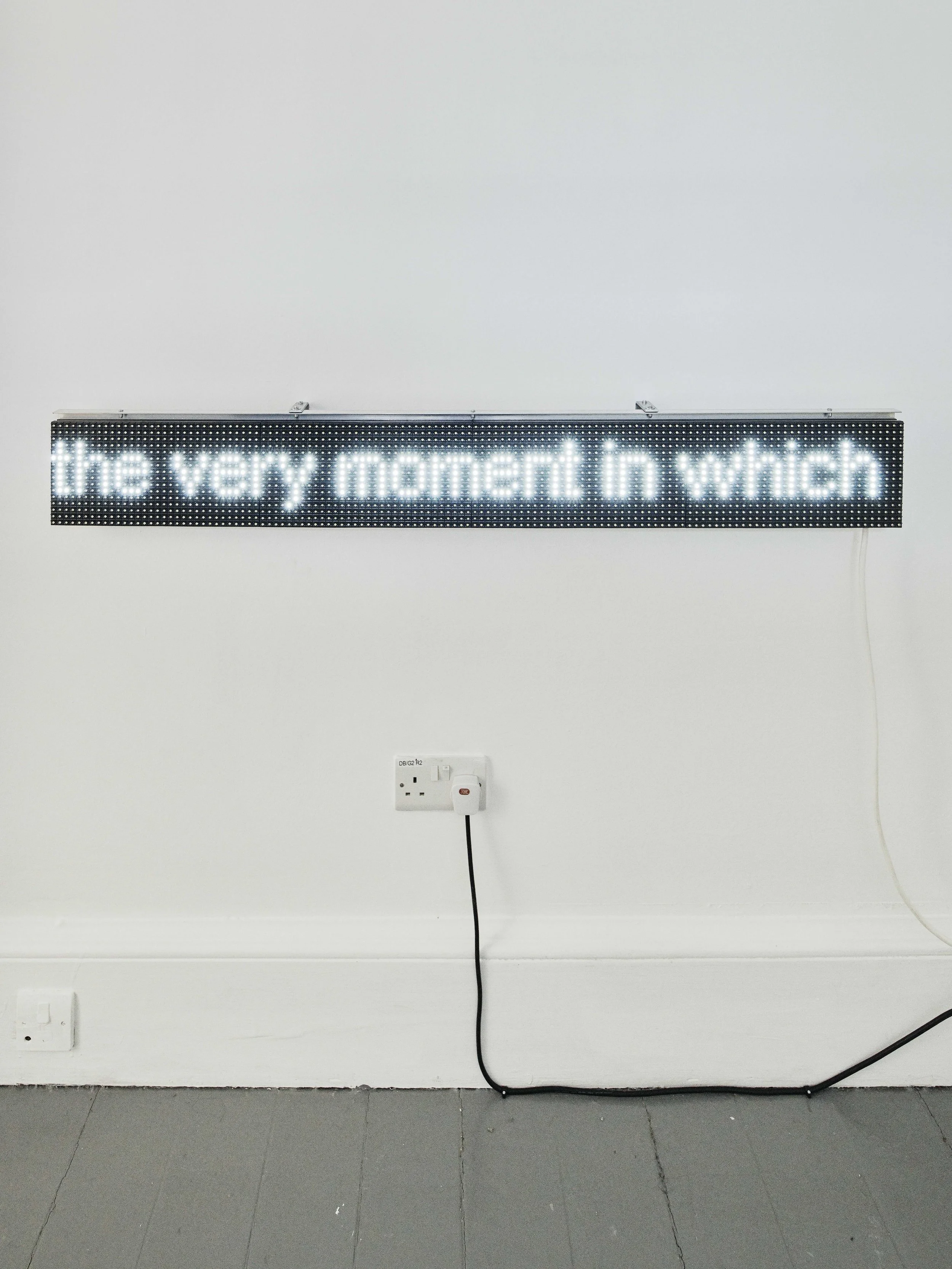
Constellation
The work may be understood as a liturgy of impact, where the meteorite is neither object nor symbol but a site, a temple without architecture, constituted by arrival. It interrupts terrestrial continuity, instituting a sacred elsewhere within matter. The stone does not signify transcendence; it is the trace of a trajectory exceeding origin and destination, suspended between stellar past and earthly apprehension.
Each poem is accompanied by erasure. The blackened page is not absence but saturation, meaning withdrawn from legibility. What remains in the residual O’s is language reduced to orbit, repetition, and hollow form. The O becomes wound and aperture, a typographic crater: a circle ruptured by collision.
These forms arrange into constellations, not as representation but enactment. They do not represent Orion but enact the gesture by which figuration is imposed upon dispersed points. The three aligned O’s in Orion’s belt are decisions, selections from an indifferent field. The constellation becomes an act of reading, a projection of order the page stages and undoes through erasure.
Betelgeuse, isolated, singular, resists alignment. Displaced from the belt, it carries instability, as though it might withdraw or collapse. In astronomical terms nearing supernova, it figures ontological precarity—the point where system gives way to contingency.
The blacked-out field is not background but condition: the horizon against which any figure emerges, here impenetrable. The viewer is left with minimal orientation, circular traces suspended in opacity. Meaning arises from the tension between what is withheld and what persists.
Thus, the series articulates a paradox: the meteorite as material singularity, yet everything gestures toward dispersion and unstable meaning. The constellations are both precise and arbitrary; the blackness conceals and constitutes; the isolated star both anchors and destabilizes.
What is offered is not a representation of the cosmos but an encounter with its unreadability, an invitation to dwell within the interval between impact and interpretation.
WALKER and WALKER
Joe Walker and Pat Walker have been collaborating since 1989 across film, sculpture, drawing and installation. Their research driven practice exploits the threshold of meaning and its construction, activating what eludes definition, the overlooked in typography, the misreading of a text, the ill defined or unresolved, to open new narratives. Representing Ireland at the 51st Venice Biennale in 2005 with Nightfall and staging major solo projects such as IMMA’s Nowhere without no(w) in 2019, they destabilise fixed readings and invite unsettled encounters with language, image and temporality.